
Shoes have always told stories. The thick rubber sole of a trail runner speaks of expedition and endurance. The tapered toe of a classic Oxford whispers of boardrooms and black-tie conventions. The delicate ribbon of a ballet flat evokes discipline, grace, and the scent of rosin. For most of fashion history, these stories were kept strictly separate — each silhouette inhabiting its own clearly demarcated cultural territory, with any encroachment across categories considered an act of bad taste at best and design heresy at worst.
That era is comprehensively over.
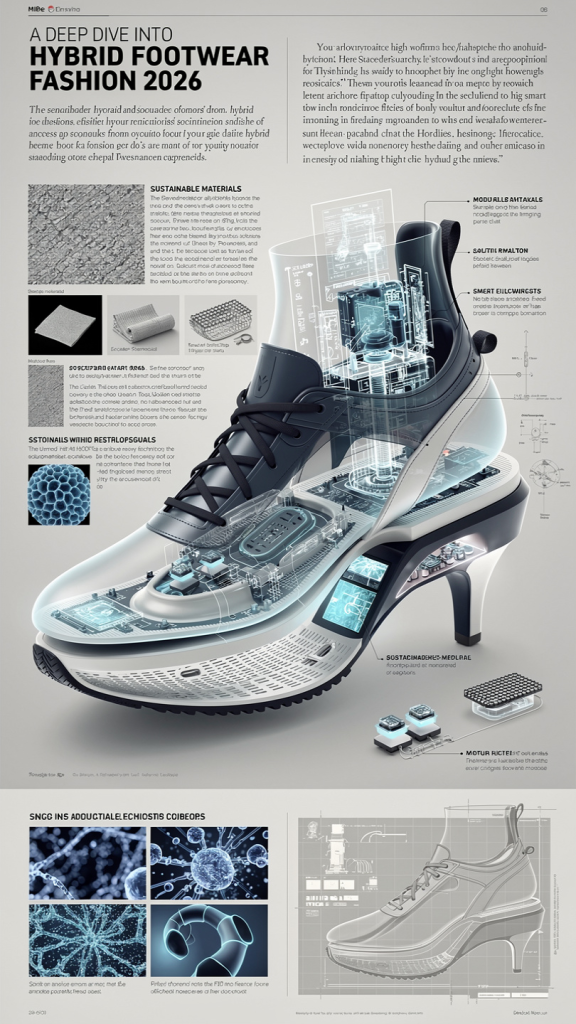
Hybrid Footwear Fashion 2026 has not merely blurred the boundaries between shoe categories. It has demolished them, sifted through the rubble, and assembled something genuinely new from the fragments. What is emerging is a footwear culture defined by synthesis: ballet flats with athletic soles, loafers wearing mule backings, Oxfords borrowing sneaker midsoles, and trainers adorned with the dainty dorsal straps of a Mary Jane. These are not confused designs. They are knowing ones — products of a moment in which consumers have collectively decided that choosing between comfort and elegance is a false dilemma they are no longer willing to accept.
The numbers confirm what the runways were already announcing. By the start of 2025, Lyst reported searches for “ballet sneakers” up 1,300%, with the Puma Speedcat Ballet landing at number three on the list of the quarter’s hottest products, and StockX recorded that sales of Mary-Jane-inspired sneakers were up more than 350% year on year. The trajectory has not slowed. Hybrid Footwear Fashion 2026 is the dominant conversation in global footwear right now, and it shows every sign of outlasting the seasonal trend cycle to become something more enduring.
Where It All Began: The Genealogy of the Hybrid Shoe
To understand why Hybrid Footwear Fashion 2026 feels so culturally urgent, it helps to trace the lineage of the idea. The hybrid shoe did not arrive fully formed from nowhere. It has a lineage, and that lineage is both longer and more distinguished than casual observers might assume.
In 1988, Margiela’s Tabi Ballet Flat — widely regarded as the first true hybrid silhouette in contemporary fashion — became the ultimate “ugly” shoe, a style that announced its wearer as irrefutably in the know. Fast forward to 2023, the “Dr Frankenstein” reputation of hybrid shoes was officially dropped, and the broader market began absorbing what had previously been the preserve of the avant-garde. What Margiela seeded over three decades ago has now flowered into a full-blown commercial and creative phenomenon.
The split-toe Tabi itself deserves particular attention in any discussion of hybrid genealogy. A classic in the hybrid shoe space, split-toe shoes are the gift that keeps on giving — the OG “ugly” Maison Margiela Tabi is like intellectual property to fashion people; the style that says you’re in the know. Its influence can be traced through the Nike Air Rift, which adapted the split-toe architecture for an athletic context, and from there into the entire lineage of category-transgressive footwear that now saturates the contemporary market.
The critical inflection point came when athletic brands and luxury houses simultaneously decided that the hybrid shoe’s moment had arrived. That convergence — mass market and rarefied luxury both pulling in the same direction — is precisely what transforms a subcultural curiosity into a civilisational fashion moment.
The Sneakerina: Ballet Meets the Pavement
Of all the manifestations of Hybrid Footwear Fashion 2026, the sneakerina occupies the most culturally visible position. It is the hybrid form that has most successfully crossed from fashion editorial into mainstream wardrobes, from runway exclusivity to high-street accessibility, from niche aesthetic provocation into genuine consensus style.
The ballet sneaker blends the athletic DNA of a trainer with the grace of a dance slipper. What began as a niche balletcore aesthetic has transformed into a dominant market force — search interest for “ballet sneakers” saw a 211% increase between the start of 2025 and the beginning of 2026. The momentum has proven self-sustaining, each new iteration generating fresh search interest and social media engagement that feeds back into demand.
The specific silhouettes driving this conversation are worth naming individually. The Puma Speedcat originally found fame in the world of Formula One driving, but its thin, flexible sole made it the perfect candidate for a ballet makeover — the Puma Speedcat Ballet merged these worlds, adding dainty satin finishes and softer lines to a shoe once meant for the pedal. It is a remarkable object: a racing shoe translated into a dance shoe translated into a fashion shoe, its entire design history compressed into a single wearable form.
Nike’s Air Rift Ballet represents a parallel narrative — a shoe that stripped away the chunky outdoor sole in favour of a flat, flexible bottom while adding satin-finished straps that evoke a dancer’s ankle ribbons. The Adidas Taekwondo, defined by its martial arts background, features a pristine design and a refined sole unit that has made it a staple in fashion capitals. The common thread running through all these iterations is the same: sporting provenance married to aesthetic refinement, resulting in objects that feel at home in both worlds without belonging wholly to either.
At the luxury end of the spectrum, hybrid sneakerinas have been appearing from Prada and Dries Van Noten in delicate satin finishes, and from Fendi and Onitsuka Tiger in vibrant colours like pink, green, and red. The designer adoption of the sneakerina confirms what the data had already suggested: this is not a trend that will dissolve with the season. It has achieved institutional endorsement.
The Derby Renaissance and the Jazz Shoe Resurgence
Hybrid Footwear Fashion 2026 extends well beyond the sneakerina’s gravitational field. Some of its most intellectually interesting expressions are arriving from unexpected directions — specifically, from the rehabilitation of two historically underappreciated silhouettes: the derby and the jazz shoe.
In his debut Celine spring 2026 collection, Creative Director Michael Rider sent model after model down the runway wearing what first appeared to be regular flats with their slim soles and glove-like fits, but upon closer inspection featured lace-up details — a hybrid of the ballet flat’s intimate fit with the structured fastening architecture of the Oxford family. Sleeker and daintier than the chunky Oxfords of previous seasons, these derby-flats sit precisely at the intersection of formal and casual, polished and pliable, historical and thoroughly contemporary.
Jazz shoes — the ’80s-inspired look — have emerged in recent collections from Celine, Jil Sander, Tibi, and Miu Miu. Like the sneakerina, the jazz shoe’s appeal resides in its hybrid essence: it possesses the low-profile, ground-hugging silhouette of a dance shoe, the structural integrity of a proper street shoe, and a retro cultural resonance that plugs directly into fashion’s ongoing obsession with the 1980s. Worn with tailored separates, fluid dresses, or even relaxed denim, the jazz shoe accomplishes the same magic trick as all great hybrid forms — it appears simultaneously appropriate and slightly surprising in every context.
Masculinity Remixed: The Menswear Hybrid Revolution
The hybrid footwear conversation is not exclusively a womenswear phenomenon. In menswear, Hybrid Footwear Fashion 2026 is producing its own quietly revolutionary transformations, driven by a consumer demographic that has grown increasingly sophisticated in its expectations of both comfort and craft.
The Mytheresa menswear buying director notes a hybrid influence coming through in smarter, runner-style sneakers with nubuck and leather uppers. Bloomingdale’s fashion director observes: “There’s a mix of nostalgia and experimentation — retro runners, subtle color, and hybrid styles are all gaining traction. Designers are moving away from overt logos and bulk, leaning instead into slimmer, low-profile silhouettes with elevated materials like suede, satin, and washed textures that feel more considered than technical.”
The slipper loafer — a construction that synthesises the slip-on ease of a house slipper with the exterior credibility of a loafer — is gaining particular traction. Bergdorf Goodman’s senior vice president notes that customers gravitate toward Loro Piana Summer Walks as examples of hybrid style shoes, as well as leather and suede loafers with flexible soles and soft uppers — comfort and convenience always in the context of quality and craftsmanship.
The hybrid Oxford with a sneaker midsole represents the most commercially significant expression of this impulse: formal leather uppers delivering the visual grammar of dress shoes while the hidden foam or EVA construction underneath provides the ambulatory experience of an athletic shoe. This is footwear that refuses to make its wearer choose between the dignity of the occasion and the practicality of the commute.
The Style-Self-Expression Imperative
Underlying every manifestation of Hybrid Footwear Fashion 2026 is a cultural shift that extends beyond footwear into the broader question of how contemporary people relate to style and identity. Fashion has departed the quiet luxury era and entered something more animated, more eccentric, more personally expressive.
Designer Larissa Muehleder describes it precisely: “Everyone is embracing their whimsy. We’ve moved past quiet luxury, and we’re even numb to logo mania. Style right now is about self-expression, individuality, and having fun with what you wear.” The hybrid shoe is the ideal vehicle for this impulse. It is, by definition, a form that refuses received categories — a wearable act of creative autonomy.
The viral dimension of this phenomenon cannot be dismissed. The sneakerina became impossible to scroll past after a simple transition video — a woman slipping on one pair of shoes and instantly shifting from morning coffee to evening plans — went viral within days. The hybrid shoe’s social media virality is not accidental. These are shoes that photograph interestingly, that invite the question “what are those?”, and that tell a layered story about their wearer’s sensibility in a single glance.
Fashion, as Refinery29’s women’s sports editor Vinciane Ngomsi observes, is presently in an era of minimalist and slim sneakers that function as lifestyle silhouettes rather than performance tools — shoes worn for what they say rather than solely for what they do. The hybrid form amplifies this communicative function exponentially, because a shoe that defies easy categorisation announces something about its wearer that a straightforward athletic shoe or a conventional dress shoe never could: that they are someone who thinks carefully about these things, and who enjoys the creative problem-solving that genuine personal style demands.
The Future Morphology: What Comes Next
Hybrid Footwear Fashion 2026 is, by its nature, a dynamic rather than a static condition. The categories being synthesised today will themselves become raw material for the next generation of hybrid forms. The creative logic is generative rather than finite.
As the sneakerina trend matures, 2026 is seeing a shift toward performance-ballet hybrids and high-fashion luxury takes. More brands are introducing modular lacing systems with satin ribbons designed to wrap around the ankle, allowing for a customisable level of ballet-inspired styling. More models will incorporate hidden eyestays specifically designed for ankle-wrapping ribbons.
The tech-utility boot — working boot silhouettes injected with performance cushioning and advanced waterproof materials — is expanding its vocabulary. The loafer-mule continues to diversify its material palette across cork footbeds, lightweight EVA soles, and supple nubuck. The Onitsuka Tiger and Versace collaboration — pairing a sneaker and a loafer within the same collection — signals that the category blurring is not merely happening within single silhouettes but across entire brand identities.
What is certain is this: the false hierarchy that once placed athletic footwear beneath formal footwear, and formal footwear beneath fashion footwear, is not returning. Hybrid Footwear Fashion 2026 has produced a new evaluative framework entirely — one in which the most interesting shoe is not the most recognisable or the most categorically pure, but the one that does something conceptually unexpected while remaining genuinely, unreservedly wearable.
The Frankenshoe era has arrived. And it is considerably more elegant than that name suggests.
You may also like
-
The Intersection of Science, Sustainability, and Efficacy in Pure Root Beauty: A Multidimensional Exploration of Clean Ingredient Sourcing and Environmental Stewardship
-
The Comprehensive Examination of Raw Root Extracts in Skincare: Mechanisms, Market Evolution, and Multidisciplinary Stakeholder Perspectives
-
The Comprehensive Ecosystem of Sustainable Root Skincare: Balancing Scientific Innovation, Ethical Sourcing, and Market Disruption in 2024
-
The Comprehensive Framework of Wellness-Driven Eco Homes: A Multidimensional Analysis of Sustainable Living, Non-Toxic Practices, and Holistic Well-Being
-
Sustainable Fashion: How the Industry is Shifting Toward Eco-Friendly Beauty and Skincare Practices